Kitchen Design Trends in Florida

What if the most enduring kitchen design trends in Florida have nothing to do with tropical motifs or coastal clichés? Many homeowners worry that a luxury renovation will eventually feel dated or fail under the pressure of Gulf Coast humidity. It's a valid concern. Achieving a balance between aesthetic longevity and structural resilience requires more than just new cabinetry; it requires architectural intent. This guide details how to integrate high-end precision with modern functionality to ensure your kitchen remains a timeless centerpiece of the home.
The following sections identify the 2026 shift toward warm minimalism and climate-adaptive materials that withstand the Florida climate. We'll clarify the difference between a contractor-led remodel and an architectural design approach. We begin by examining the transition from isolated cooking zones to seamless, indoor-outdoor living spaces that define the modern Panhandle residence.
Table of Contents
The Evolution of Florida Kitchen Aesthetics: Toward Architectural Continuity
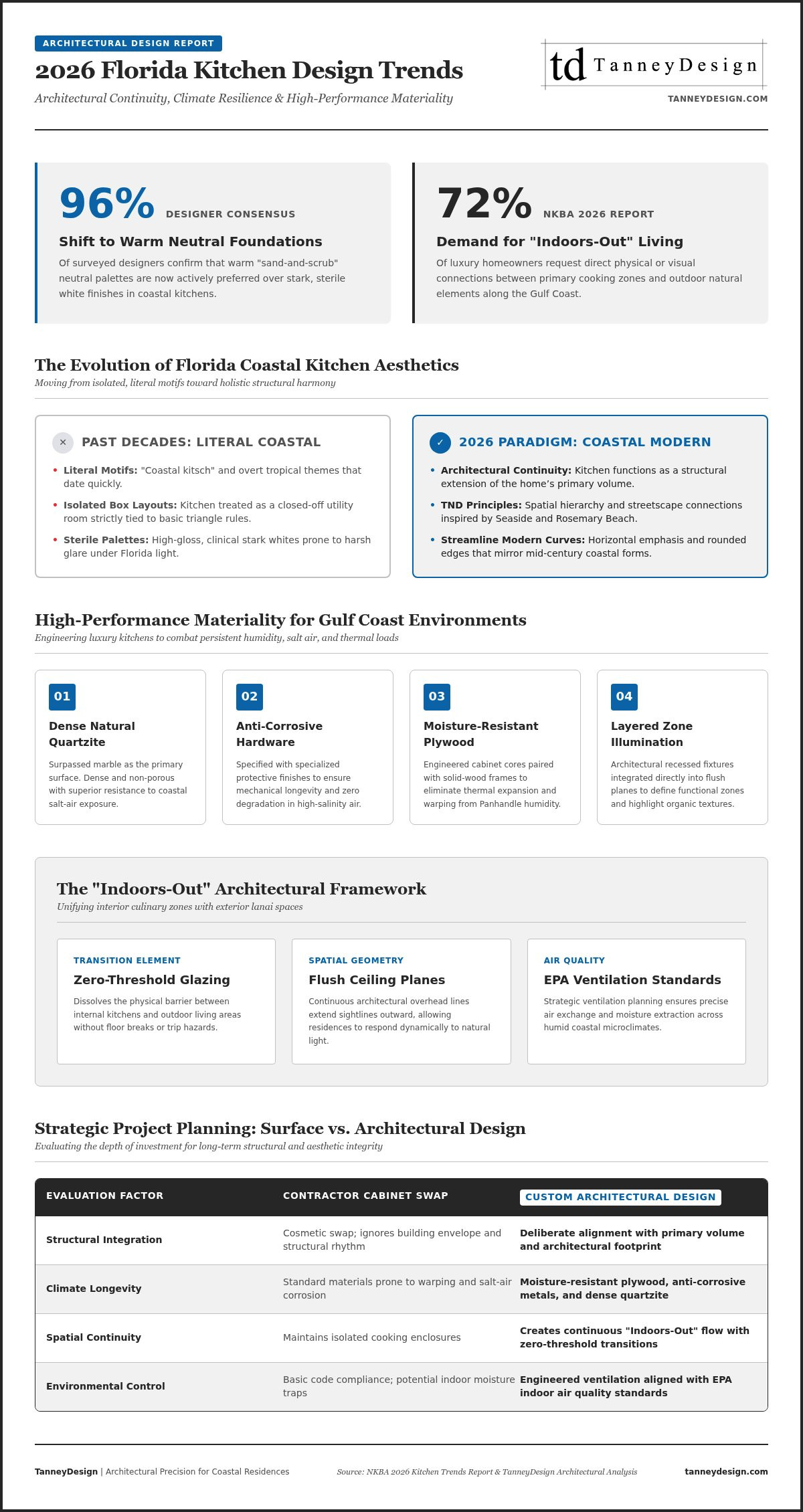
Florida kitchen aesthetics are moving away from literal tropical motifs. The "coastal kitsch" of past decades is being replaced by a refined Coastal Modern style. This evolution represents one of the most significant kitchen design trends in Florida for 2026. It prioritizes architectural continuity, where the kitchen is a structural extension of the home's primary volume rather than a separate box of cabinets. This approach moves beyond the basic kitchen work triangle principle to address how the room functions as a social and structural anchor within the residence.
Architectural Integration in Custom Home Design
Architectural integration is the deliberate alignment of structural lines with functional zones to create a unified interior environment.
Professional space planning prevents the disjointed look common in standard renovations. These projects don't just update a room; they redefine the space. By treating the kitchen as a core component of custom residential design, the layout respects the building's proportions. This meticulous planning ensures that cabinetry and appliances follow the home’s established architectural rhythm rather than fighting against it.
Essential Elements of the 2026 Florida Kitchen: Materiality and Flow
Modern kitchen design trends in Florida emphasize a seamless transition between the interior culinary core and outdoor living spaces. According to the NKBA 2026 Kitchen Trends Report, 72% of homeowners now request direct physical or visual connections to natural elements. This "Indoors-Out" flow utilizes flush ceiling planes and zero-threshold sliding glass to dissolve the barrier between the kitchen and the lanai. It allows the home's architecture to breathe, responding to the climate rather than fighting it.
Materiality has shifted toward organic resilience. Designers aren't just moving away from sterile white; they're embracing "sand-and-scrub" neutrals that mirror the Gulf Coast. Research shows 96% of designers now confirm that warm neutral foundations are preferred over stark whites. Natural quartzite has surpassed marble as the preferred surface due to its non-porous nature and resistance to salt-air exposure. This focus on durability extends to anti-corrosive hardware finishes, ensuring mechanical longevity in high-salinity atmospheres.
High-Performance Surfaces for Coastal Environments
A "material-first" approach is essential to withstand Florida's relentless humidity. This involves specifying moisture-resistant plywood cores and solid-wood frames for cabinetry so they don't warp over time. Integrating specific Florida Gulf Coast home styles ensures that interior finishes align with the local vernacular, a key aspect of modern kitchen design trends in Florida. Architectural lighting also plays a critical role, using recessed fixtures and layered illumination to define functional zones. For those pursuing custom residential design, these technical details preserve quality and aesthetic integrity for the long term.
Planning Your Florida Kitchen Design: A Strategic Approach
A successful project begins by distinguishing between a surface-level cabinetry swap and a comprehensive Custom Residential Design effort. While a cabinet remodel updates finishes, it often ignores the underlying structure. An architect ensures that kitchen design trends in Florida are supported by technical precision. This includes adhering to EPA indoor air quality and ventilation guidelines, which are vital for managing moisture and air exchange in the Panhandle's humid climate.
Achieving a seamless finish requires the coordination of architecture and interior design from the outset. This unified approach prevents aesthetic friction and ensures the kitchen feels integrated with the home's original proportions. It's about protecting long-term value through structural integrity rather than following fleeting fashions. Meticulous planning at this stage saves time and resources during the construction phase.
Hiring a Professional for Custom Residential Renovations
The transition from concept to construction requires a methodical sequence to ensure the best outcome for your home:
Step 1: Identify structural goals. Define how the space needs to change physically before selecting cabinetry colors or stone slabs. Focus on flow and volume rather than just surfaces.
Step 2: Evaluate spacial context. Consider how the renovation aligns with adjacent spaces, access points, and circulation through the house.
Step 3: Consult local expertise. Partner with a firm that understands your needs and the existing conditions. This includes specific knowledge of kitchen workflow and use requirements.
Focusing on these strategic steps ensures your kitchen remains both a functional workspace and a resilient architectural asset for years to come. It's the difference between a temporary update and an enduring home improvement.
Defining the Future of Coastal Kitchen Design
A successful renovation requires more than cabinetry updates; it demands synergy between structural integrity and refined aesthetics. Current kitchen design trends in Florida prioritize architectural continuity, ensuring high-performance materials withstand the unique coastal humidity. TanneyDesign applies space planning and construction methods refined since 1995 to achieve these results. The firm brings over 30 years of architectural experience to Northwest Florida, providing bespoke solutions for PCB, 30A, and Santa Rosa Beach. This strategic approach transforms a standard remodel into a lasting residential asset. It's about creating a space that functions as a structural anchor for the entire home. Start your custom residential design journey with TanneyDesign. Your vision for a resilient, timeless kitchen is within reach.
Frequently Asked Questions
What are the most durable kitchen materials for Florida coastal homes?
Dense quartzite and non-porous engineered surfaces are the most resilient choices for the Panhandle. Unlike traditional marble, these materials resist etching and salt-air corrosion common in Santa Rosa Beach and Destin. Marine-grade plywood and stainless steel hardware also prevent degradation from the high salinity and humidity levels found in coastal environments.
How do I choose between a kitchen contractor and a residential designer?
A contractor focuses on the physical execution and assembly of a build. In contrast, a residential designer provides the structural planning and spatial logic required for a cohesive home. For kitchen design trends in Florida, a designer ensures the room integrates with the home's architecture. TanneyDesign provides custom residential design and renovation projects that prioritize long-term structural integrity.
Are open-concept kitchens still trending in Florida for 2026?
Open-concept layouts remain a dominant preference, specifically those emphasizing "Indoors-Out" flow. Homeowners in Inlet Beach and Grayton Beach increasingly request kitchens that transition seamlessly into outdoor living areas. This trend focuses on architectural continuity, using bi-fold or multi-slide glass doors to unify interior and exterior spaces for a more expansive residential footprint.
How does coastal humidity affect high-end kitchen cabinetry?
Excessive moisture in Panama City Beach can cause standard cabinet boxes to swell, warp, or delaminate. High-end cabinetry requires moisture-resistant plywood cores and solid-wood frames to maintain structural stability. Refined construction methods, such as those used by TanneyDesign since 1995, ensure that cabinetry resists the expansion and contraction cycles typical of the Northwest Florida climate.


Comments