Custom Home Designers in Panama City Beach: A Comprehensive Guide

What if the designer you choose shapes not just your home, but how you live in it for decades to come? That's the weight behind selecting the right custom home designers in Panama City Beach, and it deserves more than a quick internet search.
Finding the right fit is genuinely difficult. The options can feel overwhelming, design styles vary widely, and the concern over whether the investment will reflect your vision is real. You're not alone in that uncertainty.
This guide cuts through the confusion. You'll gain a clear understanding of what the custom design process actually involves, what qualities distinguish a reputable designer from the rest, and how to evaluate your options with confidence. Whether you're drawn to coastal architecture, modern interiors, or a highly personalized blend of both, the decisions you make at this stage will define the outcome. By the end, you'll know exactly what to look for and how to move forward with clarity.
Table of Contents
Choosing the Right Custom Home Designer in Panama City Beach
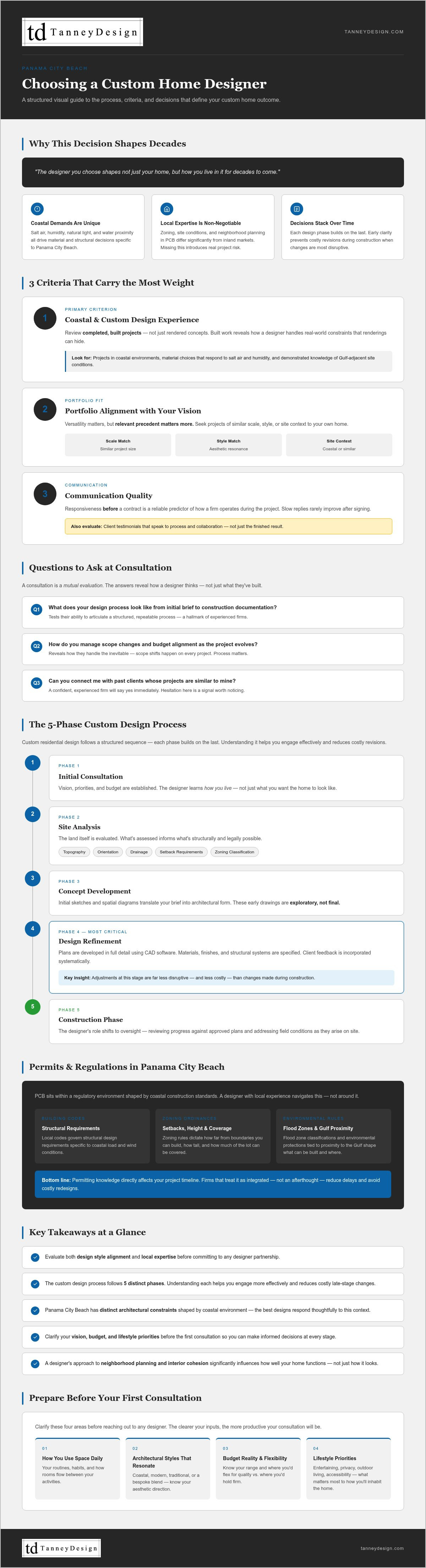
Before reaching out to a single designer, get clear on what you actually want. Consider how you use space daily, which architectural styles resonate with you, and how your home should respond to its environment. Coastal living has specific demands - salt air, humidity, natural light, and proximity to water all shape material choices and structural decisions. Designers who understand these conditions bring a different level of precision to the work.
Start your research by focusing on firms with documented experience in custom residential design within the region. Local expertise isn't a bonus; it's a baseline requirement. Zoning regulations, site conditions, and neighborhood planning considerations in Panama City Beach differ meaningfully from inland markets. A designer unfamiliar with these factors introduces unnecessary risk into your project.
Key Criteria for Selecting a Designer
When evaluating custom home designers in Panama City Beach, three factors carry the most weight:
Coastal and custom design experience. Review completed projects, not just rendered concepts. Built work reveals how a designer handles real constraints.
Portfolio alignment. Look for projects with a similar scale, style, or site context to your own. Versatility matters, but relevant precedent matters more.
Communication quality. Responsiveness during the evaluation phase is a reliable indicator of how a firm operates throughout a project. Slow replies before a contract rarely improve after one.
Client testimonials add another layer of clarity. Seek out feedback that speaks to process and collaboration, not just the finished result.
Questions to Ask During Consultations
A consultation is a mutual evaluation. Come prepared with direct questions:
What does your design process look like from initial brief to construction documentation?
How do you manage scope changes and budget alignment as the project evolves?
Can you connect me with past clients whose projects are similar to mine?
The answers reveal how a designer thinks, not just what they've built. A firm that articulates its process with clarity and calm confidence is one that's done this work before and understands what it takes to deliver.
Understanding the Custom Home Design Process
Custom residential design isn't a single event. It's a structured sequence of decisions, each one building on the last. Understanding that sequence before you begin positions you to engage more effectively at every stage and reduces the risk of costly revisions later.
The process typically moves through five distinct phases:
Initial consultation. Vision, priorities, and budget are established. This is where the designer learns how you live, not just what you want the home to look like.
Site analysis. The land itself is evaluated. Topography, orientation, drainage, setback requirements, and zoning classifications all inform what's structurally and legally possible.
Concept development. Initial sketches and spatial diagrams translate your brief into architectural form. These early drawings are exploratory, not final.
Design refinement. Plans are developed in detail. Materials, finishes, and structural systems are specified. This phase produces the documentation that builders and contractors work from.
Construction phase. The designer's role shifts to oversight, reviewing progress against the approved plans and addressing field conditions as they arise.
Detailed Steps in the Design Phase
During concept development and refinement, experienced custom home designers in Panama City Beach rely on CAD software to produce precise architectural drawings. These tools allow for accurate spatial planning, structural coordination, and material scheduling. Collaborative review sessions are built into this phase so that client feedback is incorporated systematically rather than addressed after the fact. Adjustments at this stage are far less disruptive than changes made during construction.
Navigating Permits and Regulations
Panama City Beach sits within a regulatory environment shaped by coastal construction standards, flood zone classifications, and environmental protections tied to proximity to the Gulf. Local building codes govern structural requirements, and zoning ordinances dictate setbacks, height limits, and lot coverage. A designer with regional experience understands which permits are required, how to prepare compliant documentation, and how to move through the approval process efficiently. This knowledge isn't incidental; it directly affects your project timeline.
Working with a firm that treats permitting as an integrated part of the design process, rather than an afterthought, reduces delays and avoids costly redesigns. Experienced custom home designers in Panama City Beach coordinate with local authorities early, ensuring that environmental guidelines and code requirements are addressed in the drawings before they reach the permit desk. Explore TanneyDesign's approach to custom residential design to understand how this level of coordination is built into every project phase.
Exploring Architectural Styles in Panama City Beach
Architecture in Panama City Beach doesn't exist in isolation. The Gulf's proximity, the salt-laden air, the quality of coastal light, and the rhythm of outdoor living all shape what works here and what doesn't. Styles that perform well inland often require significant adaptation before they're appropriate for this environment. Understanding that context is what separates a well-designed coastal home from one that simply looks the part.
Popular Styles for Coastal Homes
Three architectural approaches consistently prove well-suited to this region:
Modern coastal. Clean geometry, expansive glazing, and open floor plans that draw the landscape inward. Large windows and sliding systems maximize natural light while framing water views. Materials are selected for longevity in humid, salt-exposed conditions.
Traditional Florida vernacular. Deep covered porches, elevated foundations, cross-ventilation strategies, and natural materials like wood and stone. This style prioritizes outdoor living as an extension of interior space, not an afterthought.
Bungalow and craftsman influences. Detailed millwork, human-scaled proportions, and a emphasis on material quality over visual spectacle. These homes reward close attention and age with character rather than against it.
Skilled custom home designers in Panama City Beach rarely apply a single style in isolation. The most resolved homes draw from multiple traditions, adapting each to the specific site, orientation, and client lifestyle.
Sustainable Design Considerations
Coastal environments demand resilience, and thoughtful design delivers it. Sustainable choices here aren't aesthetic preferences; they're structural ones.
Material selection. Fiber cement siding, impact-rated glazing, and corrosion-resistant hardware all extend the life of a coastal home meaningfully.
Energy efficiency. Passive cooling strategies, high-performance insulation, and properly oriented openings reduce mechanical load without sacrificing comfort.
Weather resilience. Elevated construction, reinforced roof systems, and storm-rated assemblies address the real risks of coastal exposure directly.
These considerations are most effective when integrated from the earliest design phase. Custom home designers in Panama City Beach who treat sustainability as a structural priority, rather than a finish-stage addition, produce homes that perform well over time. Learn how TanneyDesign incorporates these principles into custom residential design from the initial brief forward.
Your Custom Home Starts with the Right Partner
The decisions made before construction begins define everything that follows. Choosing among custom home designers in Panama City Beach means evaluating local expertise, design process clarity, and genuine alignment with how you want to live. Those factors aren't interchangeable, and the right firm makes a measurable difference in the outcome.
A few principles hold throughout: prioritize designers with proven regional experience, understand each phase of the process before committing, and select an architectural approach that responds to the coastal environment rather than simply decorating it.
TanneyDesign brings deep expertise in custom residential design, a thorough understanding of local building codes, and a personalized approach that treats each project as distinct. The firm's work reflects a commitment to craftsmanship and client-centered design that carries through from the initial brief to the finished home.
When you're ready to move forward with clarity and confidence, start your custom home journey with TanneyDesign today. The home you've envisioned is worth building with precision.
Frequently Asked Questions About Custom Home Design in Panama City Beach
What should I consider when designing a custom home?
Start with how you actually live day to day. Room adjacencies, natural light preferences, storage needs, and how indoor space connects to outdoor areas all shape a design that functions well over time. Site conditions matter just as much as interior preferences. In coastal environments, orientation, prevailing winds, and flood zone classifications influence structural decisions from the earliest planning stages.
Budget clarity is equally essential before design work begins. Knowing your parameters allows a designer to make purposeful decisions rather than speculative ones, and it keeps the process moving without disruptive course corrections later.
How long does the custom home design process take?
The design phase alone, from initial consultation through construction documentation, typically spans several months depending on project complexity, client responsiveness, and permitting timelines. Simpler programs with clear briefs move faster; highly detailed or site-constrained projects require more time at each phase. Permit review timelines in Panama City Beach add additional duration that varies by jurisdiction and project scope.
Rushing the design phase rarely saves time overall. Decisions deferred during design tend to resurface as costly changes during construction, which extends the overall timeline far more than a thorough upfront process would have.
What are the costs associated with hiring a custom home designer?
Design fees vary based on project scope, square footage, complexity, and the level of service required through construction. Some firms charge a percentage of the total construction cost; others work on fixed fees or hourly rates. The structure depends on the firm and the project. Confirm the fee arrangement and what's included, specifically whether construction administration is part of the engagement, before signing any agreement.
It's worth noting that design fees represent a fraction of total project cost, and the decisions made during that phase directly influence construction efficiency and long-term performance. Underinvesting in design rarely produces savings elsewhere.
How can I ensure my custom home is energy efficient?
Energy efficiency in a coastal home is most effective when it's integrated structurally, not added at the finish stage. Passive strategies, such as building orientation, window placement, and shading from covered porches, reduce mechanical load without ongoing cost. High-performance insulation, impact-rated glazing, and properly sealed assemblies address both energy performance and storm resilience simultaneously.
Custom home designers in Panama City Beach who treat these principles as design priorities rather than optional upgrades produce homes that perform measurably better over time. Discuss energy goals explicitly during the initial brief so the design responds to them from the outset rather than accommodating them afterward.
What styles of architecture are popular in Panama City Beach?
Modern coastal, traditional Florida vernacular, and craftsman-influenced designs each have a strong presence in the region. Modern coastal favors clean geometry and expansive glazing; Florida vernacular emphasizes elevated foundations, deep porches, and cross-ventilation; craftsman approaches prioritize material quality and detailed millwork. Each responds differently to the site conditions common along the Gulf Coast.
The most considered homes don't commit rigidly to a single style. Experienced designers adapt elements from multiple traditions to suit the specific site, orientation, and client lifestyle, producing work that feels resolved rather than categorically assigned.


Comments